
04-05-2026, 04:18 PM
|
 |
Supercalifragilisticexpia
|
|
Join Date: Mar 2002
Location: Arlington, TX
Posts: 58,674
|
|
|
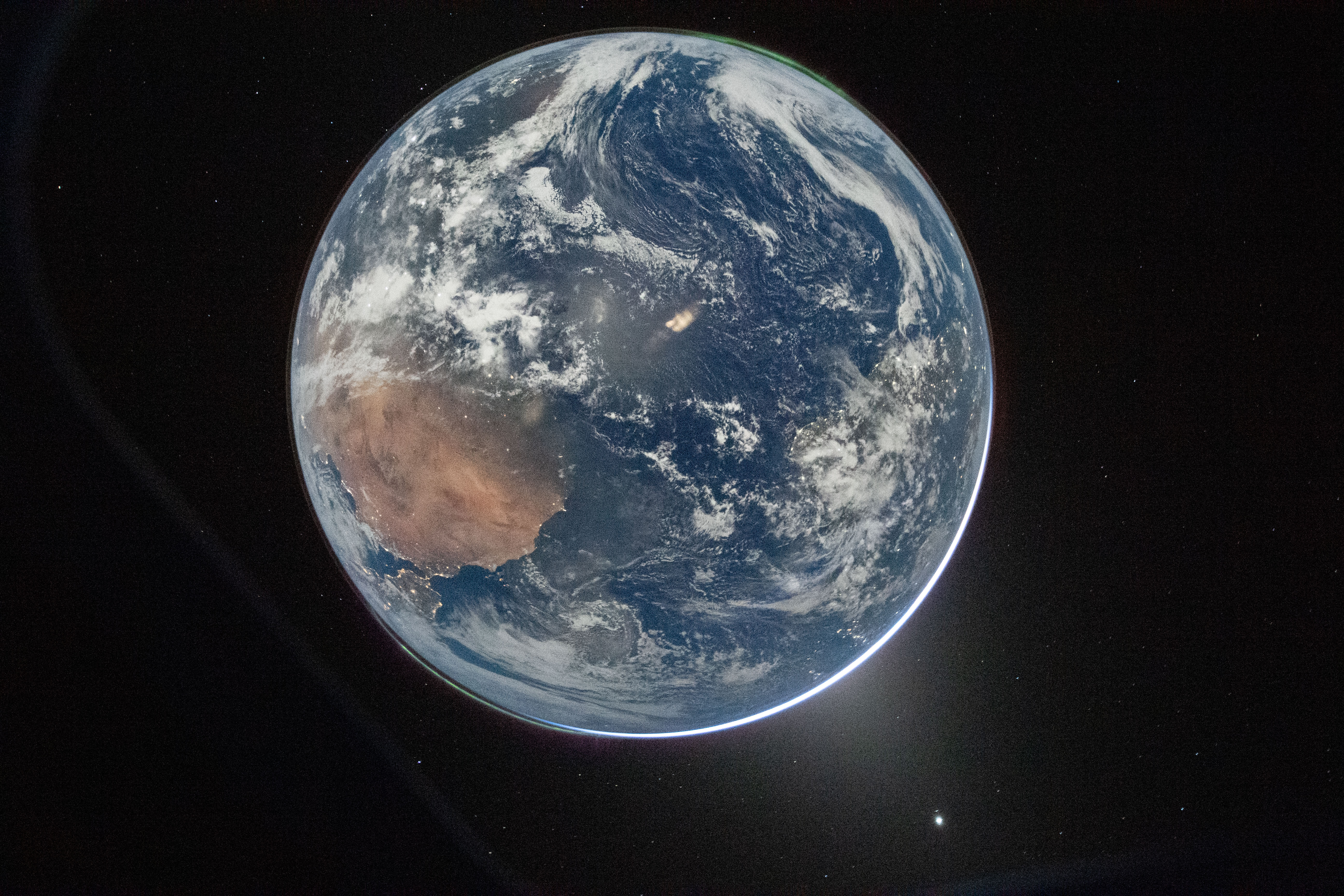
"Hello World" from Artemis - unique Earth picture
Edit - I did not shrink this picture because of the subject matter and the detail of a very unique picture.
I read the explanation and I see the picture and its still hard to wrap my head around what I am looking at.
What we are looking at is a night picture of the earth with the earth lit up by the moon, not the sun. You can see Madrid lit up along with some other cities. This pic is very surreal.
Quote:
The key clues come from NASA’s caption. “A view of Earth taken by NASA astronaut and Artemis II Commander Reid Wiseman from one of the Orion spacecraft’s window after completing the translunar injection burn on April 2, 2026. The image features two auroras (top right and bottom left) and zodiacal light (bottom right) is visible as the Earth eclipses the Sun.”
Look more closely at the image, and you’ll see a whole range of other details, too. Stars twinkle in the background, and the earth’s atmosphere is clearly visible, most obviously around a third of the globe, where it’s lit up brilliantly by sunlight. But wait – you can’t see the stars and aurora in the daytime. And if the Sun is behind the Earth, where is the light coming from that illuminates the photo?
There’s only one possible answer. This isn’t, like all those Apollo photos we’ve seen before, a daylight shot. Instead, “Hello, World” is a night-time photo, with the Earth lit solely by moonlight. We can also see city lights shining in the darkness, with Madrid lit up like a jewel in the middle of Spain.
That’s pretty amazing, isn’t it?
|
https://amateurphotographer.com/latest/photo-news/the-artemis-earth-photo-is-incredible-but-the-one-thing-that-nobody-is-telling-you-about-it-will-blow-your-mind/

Quote:
The only light source for the Earth in the shot is moonlight, which was quite strong at the time of the image, April 3rd, shortly after the full moon on April 2nd. Also on the southern hemisphere, which “Hello, World” predominantly shows: Bottom left is Africa, below it the Iberian Peninsula, and at the right edge of the photo, parts of western South America can still be recognized. To illustrate that it is an intentionally composed shot of the Earth's night side, NASA has also released the same perspective with different camera settings. Metropolitan areas on the coasts of Africa and South America appear as bright points of light there.
The stars, which are otherwise missing from many Earth photos from space – including the famous “Blue Marble” from Apollo 17 – are clearly visible in "Hello World", even certain constellations are recognizable. This is explained by the large aperture of f/4.0 chosen by the photographer. He is the commander of the Artemis 2 mission, Reid Wiseman. Like all NASA astronauts, he was trained in the proper use of the cameras on board, as he demonstrated, among other things, in a Facebook post with a video.
|
https://www.heise.de/en/background/What-NASA-s-images-of-Earth-show-and-how-they-were-taken-11245951.html
For any of the camera geeks here, there is a bunch of camera tech talk on both linked sites.
__________________
Sent from an agnostic abacus
2014 C250 21,XXX my new DD ** 2013 GLK 350 18,000 Wife's new DD**
- With out god, life is everything.
- God is an ever receding pocket of scientific ignorance that's getting smaller and smaller as time moves on..." Neil DeGrasse Tyson
- You can pray for me, I'll think for you.
- When you understand why you dismiss all the other possible gods, you will understand why I dismiss yours.
|



 Linear Mode


