Quote:
Originally Posted by Arthur Dalton

The problem with deleting the resistor by jumpering it is that will get you high fan, BUT, the wiring from the pre-resistor relay is not as heavy as the high speed circuit . So , the trick is to use the feed wire to the rsisitor [ single wire side] to a power relay and feed that relays output to the 2 wire side of the relay..that gives you high fan with a/c instead of low fan w/o a problem with the wiring for low fan.......... Fuse that new line w/25 A
If you do not use the low fan for a/c , you can also put a cabin sw jumper at the drier sw to activate it manually from the cabin..that is a popular mod for Benz guys ..great to have a manual over-ride for traffic, towing, etc..and that does not change any stock fan cicriuts, it simply gives you manual command over them. [ like puting the heater on to cure an overheat condition]
You can also lower the high fan circuit if you have the blu 2 wire sensor for high fan by bridging that sensor with a resistor for lower temp cut-in.
|
You bring up a good point. I did not think of the wire thickness.
So, you're saying install a relay in place of the resistor using the input side of the resistor as the switching signal for the relay? I have a few 12v/40a relays laying around that sounds like a good idea. This seems like a good idea actually, I would maybe recommend this to others if they are comfortable with the fans at full speed and uncomfortable with that resistor.
I do plan on having my ac recharged eventually here so I will be using it for the AC. However I honestly don't see any problems with the fans running at full speed during AC operations.
I do in fact have a switch installed to manually kick on the aux fans (low speed) as you mentioned. Just a precautionary measure. I don't have any overheating issues currently.
If I were to jumper a resistor across the blue two pin sensor, what value would it need to be to kick on the fans at say 100C? What is the default kick on resistance value?
Thanks,
Kris
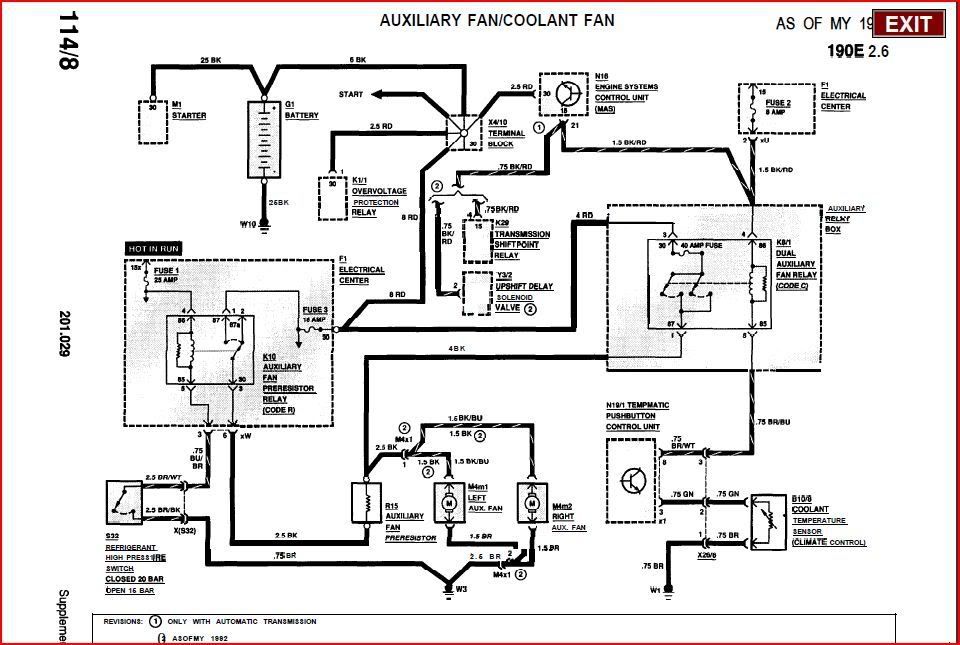
Just for reference, here is the 201 Aux Fan circuit for late model 201.029s
__________________
Cruise Control not working? Send me PM or email (
[email protected]). I might be able to help out.
Check here for compatibility, diagnostics, and availability!
(4/11/2020: Hi Everyone! I am still taking orders and replying to emails/PMs/etc, I appreciate your patience in these crazy times. Stay safe and healthy!)
82 300SD 145k
89 420SEL 210k
89 560SEL 118k
90 300SE 262k
RIP 5/25/2010
90 560SEL 154k
91 300D 2.5 Turbo. 241k
93 190E 3.0 235k
93 300E 195k