
05-22-2012, 09:03 PM
|
|
Banned
|
|
Join Date: Dec 2011
Location: Sharing my mother's basement with several liberals who can't hold a job.
Posts: 32,604
|
|
|
Reliability of Wikipedia ?
Wikipedia is a fine source of information, but it has some issues with content and at times being a factual source.
Quote:
Reliability of Wikipedia
From Wikipedia, the free encyclopedia
Jump to: navigation, search

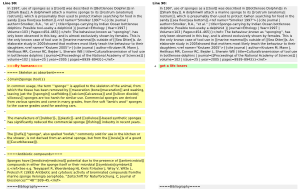 
Vandalism of a Wikipedia article. The section on the left is the normal, undamaged version; and on the right is the edited, damaged version.
The reliability of Wikipedia (primarily of the English-language edition), compared to other encyclopedias and more specialized sources, is assessed in many ways, including statistically, through comparative review, analysis of the historical patterns, and strengths and weaknesses inherent in the editing process unique to Wikipedia.[1]
Several studies have been done to assess the reliability of Wikipedia. A notable early study in the journal Nature said that in 2005, Wikipedia scientific articles came close to the level of accuracy in Encyclopædia Britannica and had a similar rate of "serious errors".[2] The study by Nature was disputed by Encyclopædia Britannica,[3] and later Nature responded to this refutation with both a formal response and a point-by-point rebuttal of Britannica's main objections.[4] Between 2008 and 2010, articles in medical and scientific fields such as pathology,[5] toxicology,[6] oncology[7] and pharmaceuticals[8] comparing Wikipedia to professional and peer-reviewed sources found that Wikipedia's depth and coverage were of a high standard. Concerns regarding readability have been raised.[by whom?][9] However, omissions sometimes remained an issue, at times due to public relations removal of adverse product information.[citation needed]
Wikipedia is open to anonymous and collaborative editing, so assessments of its reliability usually include examinations of how quickly false or misleading information is removed. An early study conducted by IBM researchers in 2003—two years following Wikipedia's establishment—found that "vandalism is usually repaired extremely quickly — so quickly that most users will never see its effects"[10] and concluded that Wikipedia had "surprisingly effective self-healing capabilities".[11] A 2007 peer-reviewed study stated that "42% of damage is repaired almost immediately... Nonetheless, there are still hundreds of millions of damaged views."[12]
Several incidents have also been publicized in which false information has lasted for a long time in Wikipedia. In May 2005, a user edited the biographical article on John Seigenthaler Sr. so that it contained several false and defamatory statements.[13] The inaccurate information went unnoticed until September 2005, when they were discovered by a friend of Seigenthaler. After the information was removed from Wikipedia, it remained for another three weeks on sites which mirror Wikipedia content.[14] A biographical article in French Wikipedia portrayed Léon-Robert de L’Astran as an 18th century anti-slavery ship owner, which led Ségolène Royal, a presidential candidate, to praise him. A student investigation later determined that the article was a hoax and de L’Astran had never existed.[15]
|
Reliability of Wikipedia - Wikipedia, the free encyclopedia

|