If the glow plugs seal, they won't affect compression, even if they are broken.
As the diaphragm wasn't torn and the governor vacuum chamber holds vacuum, there was no need to adjust the idle.
The gorilla knob cable should pull on the lever when in the starting position and push on the lever when in the stop position. When at the drive or glow position, the lever should not be actuated. You can try pushing the accelerator pedal a bit during and after starting. Don't high rev the engine before there is oil pressure.
Quote:
Originally Posted by Mojoan

so if i understand that correctly what you're saying is that it's simply impossible for a diesel to die from too much fuel? Are you 100% sure?
(Also another thought that just occured: I filled the IP with oil, and I remember reading somewhere that it somehow gets rid of excess oil. Does it do that by injecting it? That would make too much fuel very possible.)
I'm just asking this question specifically, because I don't want to go about changing the diaphragm for a lot of money just to have a non-running engine afterwards and another problem to fix
|
Diesels don't die from too much fuel, they may smoke or (if the governor doesn't work or in your case, start the engine without the air hose attached) overspeed, but they don't die. During starting the governor injects even more fuel than normally under full-load condition, just to help starting.
The IP has its own oil supply, that should be changed every time you change the engine oil.
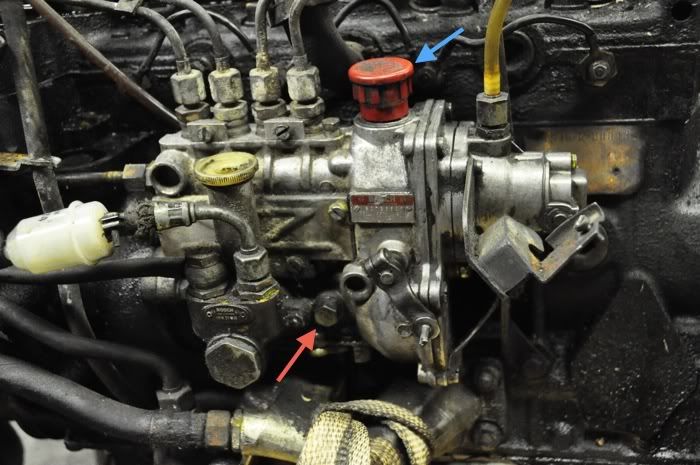
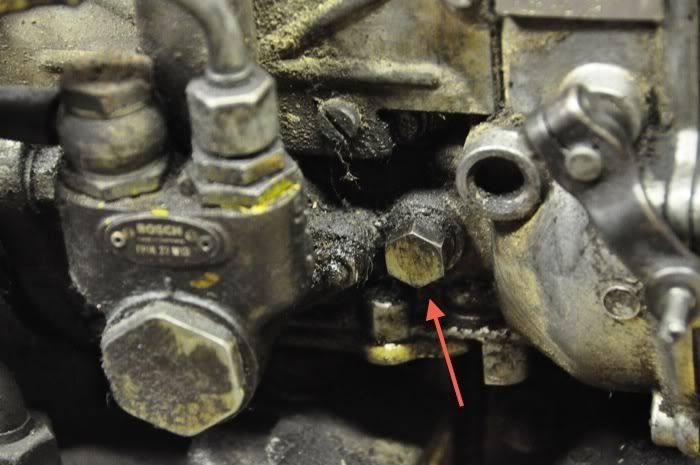
Unscrew the level screw (it is hollow, so don't need to remove it entirely) and let diesel/oil leak out. Have some rags ready. The screw is at the red arrow in the picture below:
Close-up:
Unscrew the red filling cap (blue arrow), pour in engine oil until fresh engine oil comes from the level screw. That usually takes about 200 ml or 6–8 fluid oz.
Screw back the level screw and put back the red cap and you are done.
There is a vent tube at the back of the pump, if the level of oil/diesel rises too much, it will come out of this vent tube.