Quote:
Originally Posted by davidmash

My solar panels (should I get them) do not power my house at all...ever. They send power directly to the grid and I buy power from the grid to power my house. No idea why or how this works and it makes no sense. At any rate, the phasing issue is not an issue since it does directly to the grid. When the power goes out, there is a switch to cut the feed to protect workers on the line. The generator would be needed to power the house.
I just do not understand why the solar cannot power my house like the generator does and if the grid goes down, a switch kicks in to kill power back to the grid.
|
Ok, let's begin by getting this clear: solar panels NEVER power the grid directly. The solar array is producing DC power...probably 48V DC. The power company supplies 120AC, 60hz current. compare:
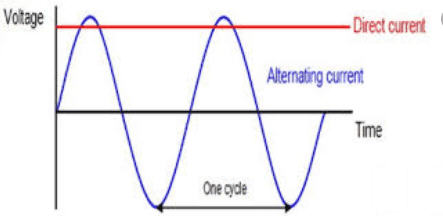
Your inverter converts the DC power produced by your cells (or supplied by your batteries to 120VAC, 60hz, so that it's compatible with the grid and with all of your appliances. And in order to feed power back to the grid, it has to precisely match the phasing on the power line. If the power line and inverter current aren't precisely phase matched, then the power you are 'selling' back is just wasted as heat, and can damage equipment, both in the grid and in any customer equipment plugged into the grid. When there's a phase mismatch, the power trace looks like the top picture. When the inverter is operating correctly, it looks like the bottom:

The way the inverter creates the correct feed is by sensing line voltage, and synthesizing a matching output feed. No line voltage, no means of clocking the correct phase. In addition, shutting down the inverter when line voltage goes away is a critical safety factor: imagine that your system was supplying the entire grid in the event of a black out. Or if a worker is repairing a down line while you are pumping current into a line he expects to be unpowered
Now let's talk about the generator. You're never going to be on generator when the power grid is supplying power. So it's not concerned with phase matching. It doesn't require an inverter at all, and doesn't have to clock the power line feed. It supplies 60hz current by virtue of being a rotating machine, operating at a fixed RPM. So when the generator engages, it flips a switch, called a transfer switch, that disconnects the power line feed and isolates the house from the grid. To switch back, you usually turn the generator off manually and then reset the transfer switch, although there are automatic switches.
To do something similar with solar, you would need an inverter which can either supply its own clock when the grid was down, or sense the phase of the grid when line power was available. And when the grid was offline, it would need to isolate the house for safety. And then switching back to the grid would require several steps to achieve phase match. So there would be a whole lot more going on.