


|
|
|
|
|
#1
 09-17-2007, 01:57 PM
|
||||
|
||||
|
Question regarding vibration damping
Is there a way to determine the frequency attenuation characteristics of damping material from a spec sheet?
I'm looking for something (cheap) that can absorb/attenuate optimally in the 2250 to 2450 Hz range. Thanks, Bot 
|
|
#2
09-17-2007, 02:02 PM
|
|||
|
|||
|
Normally, the material is not the only player in the game of vibration isolation. How you support the component and the attachment points for the material are sometimes more important than the material itself.
Tuning a dynamic system to reduce vibration is a complicated task that's usually iterative. Some of the latest computer models do make a decent effort toward that end, however.
|
|
#3
09-17-2007, 02:03 PM
|
||||
|
||||
|
Dynamat???
http://www.dynamat.com/technical_technical.html They have other product lines that they use in large applications. Give em a call. http://www.dynamat.com/oem_acoustic_oe_solutions.html
__________________
-Justin 91 560 SEC AMG - other dogs dd 01 Honda S2000 - dogs dd 07 MB ML320 CDI - dd 16 Lexus IS250 - wifes dd it's automatic.
|
|
#4
09-17-2007, 02:49 PM
|
||||
|
||||
|
Quote:
If this doesn't work then we're looking at spending big bucks.
|
|
#5
09-17-2007, 03:03 PM
|
||||
|
||||
|
Quote:

|
|
#6
09-17-2007, 03:07 PM
|
|||
|
|||
|
Quote:
|
|
#7
09-17-2007, 03:37 PM
|
||||
|
||||
|
Quote:
If this product doesn't work he said that I would most likely have to look at fluid dampers -- much more expensive. I will avoid that as it would involve airframe mods -- attaching directly to the frame--which gets the FAA approval process involved and then our even more demanding internal approval. Been there. No thank you. We'd most likely just accept a lower quality product rather than go that route.
|
|
#8
09-17-2007, 04:00 PM
|
|||
|
|||
|
Chiming in with my ignorance
Just a thought here. Are you relating prop-tip noise frequency with engine rpm (2250-2450....it seems like it) or did you actually measure the frequency? If the former, note that sound frequency is in Hz, or cycles per second, and the prop noise would be on the order of cycles per minute. Also, the prop will have two or more tips which would change the calculations. A two-bladed prop at 2400 rpm would produce an 80 Hz sound (not even considering the harmonics or the exhaust noise).
I could be all full of it and usually am but I wanted to draw attention to this in case it applies and you hadn't considered it.
__________________
1983 M-B 240D-Gone too. 1976 M-B 300D-Departed. "Good" is the worst enemy of "Great".
|
|
#9
09-17-2007, 04:24 PM
|
||||
|
||||
|
Quote:
Bot
|
|
#10
09-17-2007, 05:36 PM
|
|||
|
|||
|
Quote:
I don't see how the Dynamat is going to eliminate this vibration. Rubber mounts..........or fluid filled mounts............to the airframe that are tuned to the desired frequency are definitely the way to go. Naturally, the problems associated with modifying the airframe for such mounts are extensive.
|
|
#11
09-17-2007, 05:39 PM
|
||||
|
||||
|
Quote:
__________________
Never a dull moment at Berry Hill Farm.
|
|
#12
09-17-2007, 05:44 PM
|
|||
|
|||
|
Quote:
However, it might be possible to attach a suitable mount to the floor of the aircraft and avoid the airframe...........and to that mount would be rubber attachment pieces that would dampen the vibration from the engines and/or the props.
|
|
#13
09-17-2007, 06:12 PM
|
||||
|
||||
|
Quote:
Camera angle set so the frame's lower limit is just above the floats. Looking at monopod mounts bolted to a plywood "table", with the table clamped to the frame. isolate vibration from the aircraft via pads on the clamps and "table" and also between the individual monopods and the cameras. Cameras run off battery and to tape to prevent having to tap into the 65 amp airplane alternator, which aside from avionics, is also running a couple of computers and a 3rd camera (CIR HDV) already belly-mounted through the fuselage (FAA approved, etc). EE suggested that the operating load on the alternator not approach 70% of rated capacity. An EE who specializes in avionics suggested 50%. We're 'currently' (he-he) at about 50%. My butt-mounted accelerometer tells me that the prop-induced vibration overwhelms valves, exhaust and noise. All vibration is going to degrade the resolution of the camera as the effective moment of the line-of-site will amplify even the tiniest movement. However, this is not going to be used on "Discovery Channel" nor will it be used for mapping, which in either case, require extremely stable imagery (and for which there are ample platforms already in use). What I want is video better than what I get by holding the camera, window open, and out of the slipstream. Also, I want video out of both sides of the aircraft and a hard mount is the only way --- as the pilot already has enough to do without videotaping as we go into a stall and death-spiral to the ground in the name of videography. You guys are really helping clarify my thinking and refining plans. Keep those cards and letters coming. With your input, this might even work! B
|
|
#14
09-17-2007, 06:37 PM
|
|||
|
|||
|
Quote:
Your plan to isolate via pads on the clamps and/or table should be effective.........however, I believe you'll need to use rubber of a specific durometer to address the specific frequency that you seek. I don't think you'll need fluid filled mounts to achieve a measure of success.
|
|
#15
09-17-2007, 10:14 PM
|
||||
|
||||
|
Here's a picture of a rig I made my buddy years ago for him to run a video camera in a helicopter. He just strapped it in the seat next to him. Make the "U" shaped piece under the camera out of 1/4" steel to increase the mass of the camera. The frame is SCH 40 1.5" PVC. For the suspension, simply use bungies. You'll have to wrap them tightly to keep the camera from wallowing and nodding. It's just a matter of experimenting until you find the combination that works. To tighten up the bungies, simply wrap more turns around the frame. Drill a 1/4" hole in the bottom of the mount and use the tripod mount hole in the camera to secure it. This makes it easy to remove and to operate the controls.
Maybe some version of this will work for you. 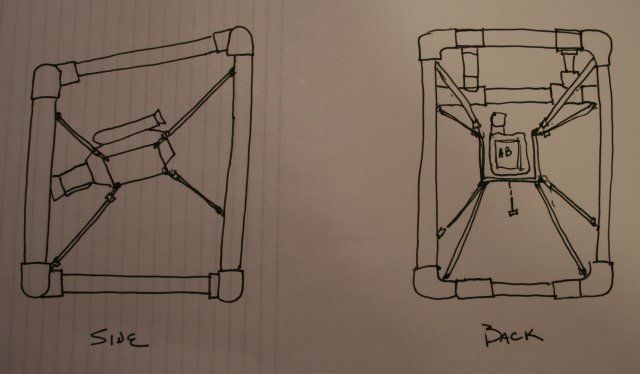 It was just quicker to hand draw it than to fool with Autocad... 
__________________
-Evan Benz Fleet: 1968 UNIMOG 404.114 1998 E300 2008 E63 Non-Benz Fleet: 1992 Aerostar 1993 MR2 2000 F250
|
 |
| Bookmarks |
|
|


 Linear Mode


