


|
|
|
|
|
#1
 07-27-2014, 09:42 AM
|
|||
|
|||
|
W201 KE Jetronic strange problem
Good Morning,
I thought I'd toss to the forum for advice - been chasing a poor/no start/poor running condition for some time on my 1991 190e 2.6 that previously ran beautifully - 98K miles on the car. I've attempted most electrical/fuel troubleshooting, but if the car starts, and I monitor duty cycle, after warm up the cycle drives to "0.0," after going into closed loop. If I disconnect the EHA, it goes to 90+ and stays there. Adjusting the mixture screw with the 3mm allen wrench does not appear to have any impact. Vacuum is at best 16" Hg, and can be as little as 10", but I can't seem to locate a vacuum leak. Compression is 180-190 on all six cylinders (cold). Fuel Pressure is 79 psi at the top of the FD, 72 at the bottom. I had rebuilt the FD back when this was just an intermittent problem. Temp sensor is relatively new, and checks within spec at the EZL and the sensor. Getting spark to plugs. Oxygen sensor voltage is 0.85v when EHA connected and .27v disconnected, which seems to match rich/lean conditions. I'm thinking there is a mechanical issue with the air-flow sensor, lever arm, mixture adjustment - so I'm prepared to remove the entire assembly to check. Any other ideas? 
|
|
#2
07-27-2014, 10:14 AM
|
||||
|
||||
|
Many weirdo **** electrical problems on a W201 end up being reported as a dodgy overload voltage protection thingy (OVP)
(Oh and good afternoon by the way!)
__________________
1992 W201 190E 1.8 171,000 km - Daily driver 1981 W123 300D ~ 100,000 miles / 160,000 km - project car stripped to the bone 1965 Land Rover Series 2a Station Wagon CIS recovery therapy! 1961 Volvo PV544 Bare metal rat rod-ish thing I'm here to chat about cars and to help others - I'm not here "to always be right" like an internet warrior 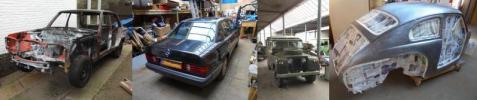 Don't leave that there - I'll take it to bits!
|
|
#3
07-27-2014, 12:16 PM
|
|||
|
|||
|
I would say that your manifold vacuum reading is low. Could be an exhaust blockage as well as a vacuum leak ...
Pelican has a decent tech article on tracking vacuum leaks on an M104, if you haven't read it already. Pelican Technical Article: Mercedes Benz - Fixing Common Vacuum Leaks
|
|
#4
07-27-2014, 03:59 PM
|
|||
|
|||
|
Stretch,
Thanks for the suggestion. OVP was one of my original thoughts, but I had replaced, and also swapped out with my other ('93) 190e 2.6 with no improvements. Maki, Thanks for the tip - I've checked through the use of solvent spray with no luck, but I could have missed a spot - with review the article and re-look for a vacuum leak...assuming I can get it started.
|
|
#5
07-28-2014, 07:55 AM
|
|||
|
|||
|
Update
Again - thanks for the feedback - my initial reply did not post for some reason. I found that 14-18 In Hg is the spec for these cars - so 15-16 is in the range. No other vacuum leaks identified - but I still need to check the brake booster, and OVP had been replaced.
What I did find: Even though FP seemed fine, I swapped out the FPR with the working '93. It did not improve, but did notice that with the '93, I got quite a volume of fuel flow from the return line when I disconnected the FPR. On the '91 - only a few drips. Any significance to that? Also, in comparing the effort required to deflect the sensor plate on both cars, the '93 was significantly stiffer than the '91. On the '93 the plate would go down with very light finger pressure - any significance to that?
|
|
#6
07-30-2014, 09:19 AM
|
|||
|
|||
|
Update
Mysteriously, yesterday afternoon I was able to set the duty cycle to the 45-50% range. I don't know if it will stay fixed - will run again later today. I blieve what is happening is something is catching or binding in the lever arm that the sensor plate attaches to in the fuel sensor/distribution assembly. If the problem repeats itself, I will go through the removal and disassembly ordeal.
I did go through the process to center the air sensor plate in it's bore, although I really don't think it was binding there. The instructions from the FSM calls for a .005" clearance around the circumference when the engine is off. You can find some paper that is close to that thickness, cut four 1/4" wide strips and use as gauges. You'll need a #25 torx to remove the two screws that secure the bridge, and a 10mm socket to loosen the plate nut.
|
 |
| Bookmarks |
|
|


 Linear Mode


