View Single Post
  #7  
Old 10-02-2011, 01:54 PM
Stretch's Avatar
Stretch Stretch is offline
...like a shield of steel
 
Join Date: Sep 2009
Location: Somewhere in the Netherlands
Posts: 14,461
Quote:
Originally Posted by New2MB View Post
I scrolled through that link, not seeing what it is you are referring to though, what do I need to be careful of with the adjustment?
There's two bits in there

1)

Quote:
Originally Posted by Army View Post
Whilst I'll be covering most of the information in the chapters for resealing and adjusting the steering box in the FSM I encourage you to read through the chapters as well. Especially if:-
...

In the W123 FSM there are two chapters that are concerned with measuring the friction in the steering system. One is covered in the refurbishment of the steering box chapter 46-220 (which is the subject of this thread) and the other for measurement of the steering system fitted to the car with the wheels on the ground: This is chapter 46-120 which can be briefly summarised as wheels on ground, engine at idle => force required to turn steering on steering wheel nut should not exceed 5-7 Nm.


Please note chapter 46-120 is a check. It is only a check – not a method of adjustment. From comments on this forum I understand that adjusting the steering box play in accordance with the check procedure in 46-120 or just nipping up the adjustment screw is quite commonly done. Fair enough – but – before you do that please have a look at the final adjustment procedure at the end of this DIY... I have some extra information and a warning for you!

...
2)

Quote:
Originally Posted by Army View Post
Now that the assembly is complete you are left to do the final adjustment.


Slacken the adjusting screw (turn clockwise when facing it) so that the output shaft can be easily rotated.


I recommend that you now take the time to wind the input shaft from stop to stop and make sure that the gearing feels smooth and that it does not bind (as the FSM puts it). You should be able to feel a slight change in stiffness in the centre of the travel of the output shaft.


To keep track of the travel of the output shaft I made some marks on a piece of masking tape showing the furthest points of travel and the centre position.

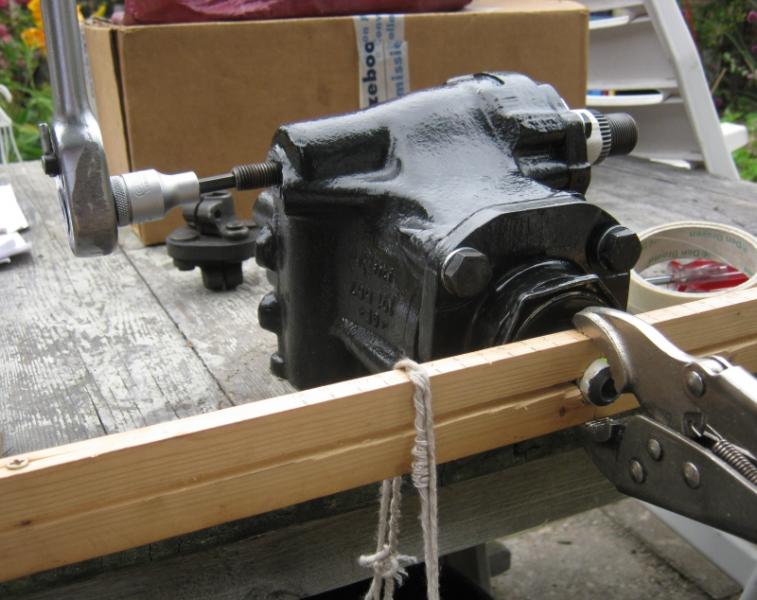


The FSM says to now measure the friction of the steering box. Place your balancing device back on the input shaft and measure the friction required to turn the output shaft (and thus the input shaft) beyond the centre position.


You are now meant to turn the adjusting screw in an anti-clockwise direction (when facing the screw) until the friction is increased by 40 – 60Ncm.


According to the FSM, in real terms this means that the amount of torque applied to the input shaft in order to move the output shaft beyond the centre position should be in the range of 110 – 160Ncm.


Warning – don't forget about the difference between Newton metres and Newton centimetres!


If you tighten the adjusting screw too far do not be tempted to just back it off a bit. That little amount of clearance at the end of the Pitman shaft / output shaft and the adjusting screw helps you to loose your place. I thought I could get away with doing this but I found that I couldn't. After working the steering from stop to stop I found that the friction changed slightly from the amount that I had previously set.


For this reason I recommend that you start all over again – tighten the adjusting screw until it is stiff to move and then repeat the adjustment process as detailed above.


I don't know this for sure but I think this might be the reason why some people have had trouble adjusting steering boxes by just nipping up the adjustment screw. If you decide to do this quick adjustment to your car I recommend that you only turn that pesky adjusting screw in an anti-clockwise direction!
Like I said before I don't want to scare you off - I just want you to know that you might make matters worse if you are not careful.
__________________
1992 W201 190E 1.8 171,000 km - Daily driver
1981 W123 300D ~ 100,000 miles / 160,000 km - project car stripped to the bone
1965 Land Rover Series 2a Station Wagon CIS recovery therapy!
1961 Volvo PV544 Bare metal rat rod-ish thing

I'm here to chat about cars and to help others - I'm not here "to always be right" like an internet warrior


Don't leave that there - I'll take it to bits!
Reply With Quote