


|
|
|
|
|
#91
 08-22-2012, 10:24 PM
|
|||
|
|||
|
Yes
Yes, I would. Thanks for all of the great info in this thread. I am thinking about doing this. I have all of the parts except for new axles that I need to get. But have all of the bushings.
It looks like taking it out assembled as in your picture would make it much easier to continue from there. Thanks, Marc. 
|
|
#92
08-22-2012, 10:58 PM
|
|||
|
|||
|
I wish you the best on this project, not as difficult as it seemed, now that I have remove the assembly, replaced the parts and reinstalled it. once you start into the project, things will fall into place that you read, as you remove them.
Let us know how you are doing as you go along. Just be safe, have the vehicle securely stabilized so it can`t move forward or back in any way. once the rear suspention is out and you start looking at the rear up on stands and the front wheels blocked, it gives you an errie feeling. hope the ground doesn`t start shaking, we get that out west. I copied this line from Dieseldan. Just a note - I personally think this job is extremely dangerous. It would be really easy to just drop the rear of the car - best case scenario onto the floor, worst case scenario onto yourself. Please please please future readers use a lot of caution if you are going to attempt this. Charlie
__________________
there were three HP ratings on the OM616... 1) Not much power 2) Even less power 3) Not nearly enough power!! 240D w/auto Anyone that thinks a 240D is slow drives too fast. 80 240D Naturally Exasperated, 4-Spd 388k DD 150mph spedo 3:58 Diff We are advised to NOT judge ALL Muslims by the actions of a few lunatics, but we are encouraged to judge ALL gun owners by the actions of a few lunatics. Funny how that works
|
|
#93
07-31-2014, 12:14 AM
|
|||
|
|||
|
Great thread. Thanks a lot!
After reading everything, I have some questions/comments. HELP PLEASE! Quote:
Quote:
Quote:
My interpretation is to jack up the diff. a little bit so that everything is not hanging from the diff. mount at such a large angle. Jack it up high enough so that you still have access to torque the trailing arm bolts. Then place a level on the axel shaft and jack up the trailing arms with additional jacks until they have completely horizontal. Then use a string to measure the distance from differential mount to hub centre on each axel to confirm the distances are the same. Then torque. This is with everything in the car. Is this correct, or am I missing something?
|
|
#94
07-31-2014, 02:22 AM
|
||||
|
||||
|
Quote:
...I've had Febi rubber parts die within a winter before - but that was tie rod end boots not suspension bushings... Quote:
__________________
1992 W201 190E 1.8 171,000 km - Daily driver 1981 W123 300D ~ 100,000 miles / 160,000 km - project car stripped to the bone 1965 Land Rover Series 2a Station Wagon CIS recovery therapy! 1961 Volvo PV544 Bare metal rat rod-ish thing I'm here to chat about cars and to help others - I'm not here "to always be right" like an internet warrior  Don't leave that there - I'll take it to bits!
|
|
#95
07-31-2014, 05:43 AM
|
|||
|
|||
|
To be clear, it does not matter how much downward angle there is on the differential as it it slopes down from the diff mount, as long as the two axels are horizontal, I can torque the bushing bolts to 89 ft-lbs?
Has anyone successfully removed the trailing arms bushings without cutting off the flange, or damaging the bushing in some way? If so, how? I went to wiskeydan's post about his homemade bushing press, but he too cut off the rubber bushing flange. I was thinking I might try using a 2-jaw puller in reverse. I might be able to squish the puller's jaws into the bushing flange area to grab onto the trailing arm. Then use a C-clamp or a vice to squish the jaws of the puller tighter and tighter together to maintain grip on the trailing arm. Then tighten the screw on the puller, which will drive the bushing out. EDIT: If I ultimately fail and need to order new bushings again, is Boge or Lemforder the better brand in this regard? Last edited by feipoa; 07-31-2014 at 05:56 AM.
|
|
#96
07-31-2014, 07:39 AM
|
||||
|
||||
|
Quote:
So with the car supported on axle stands and the differential mount in place and the front sub frame mounts fitted as well => Remove the rear wheels and raise or lower the wheel so that the axle is straight so that you get the ideal position. You need to do this when the springs are not fitted to the trailing arm. It sounds like you've been doing just the trailing arm bushings one at a time with the springs in - is that correct? If so then I would put some weight in the back of the car / fit a spring compressor and compress the rear springs and then try to squeeze under there to tighten the bushings (but bloody hell what a drama!) To be honest I've always tightened my trailing arm bushings with the sub frame out of the car - with the axles out you can look through the wheel hub and centre it like sights on a rifle against the centre of the differential output Quote:
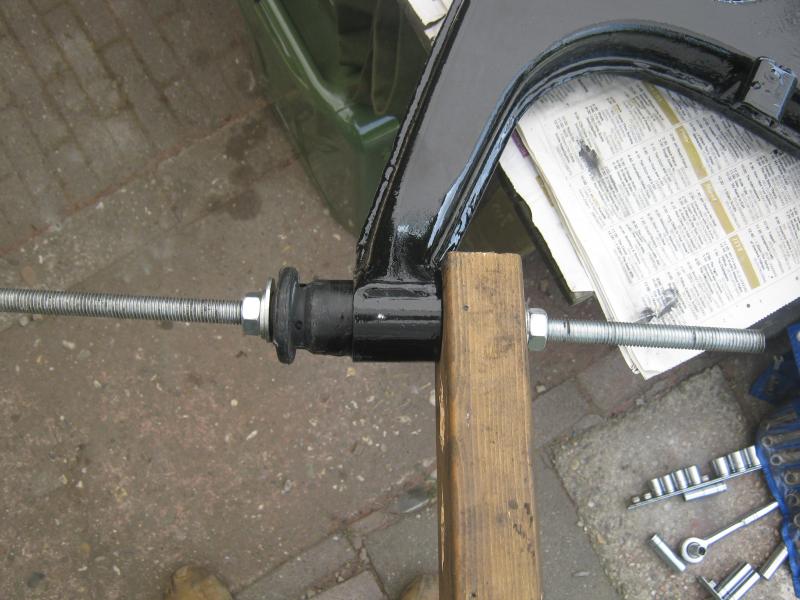 Where you see the bushing in this picture there was a steel plumbing fitting and the block of wood. The threaded bar went through as above but on the right hand side there was a washer and a nut and a lock nut. A bit further out from the washer and nut next to the bushing I had two more nuts locked together so I could tighten both sides of the trailing arm. Quote:
Quote:
__________________
1992 W201 190E 1.8 171,000 km - Daily driver 1981 W123 300D ~ 100,000 miles / 160,000 km - project car stripped to the bone 1965 Land Rover Series 2a Station Wagon CIS recovery therapy! 1961 Volvo PV544 Bare metal rat rod-ish thing I'm here to chat about cars and to help others - I'm not here "to always be right" like an internet warrior Don't leave that there - I'll take it to bits!
|
|
#97
07-31-2014, 04:28 PM
|
|||
|
|||
|
Both rear springs, shocks, wheels, calipers are removed. I've plugged the brake line.
I have released the e-brake cables from the centre coupler under the car. The axel shafts are installed. The front and rear of the chassis are raised up on four large jack stands, positioned near the vehicle's jack holes. I use a plate of 3/8" steel between the jack and the chassis so that the stands don't dent the body. The differential is currently mounted to the diff mount, which is mounted to the chassis. The differential is mounted to the subframe, however the subframe is not mounted to the chassis (it is unbolted). With the sub-frame unbolted, the differential and sub-frame will articulate downward. This downward tilt is needed to have access to the trailing arm bolts. I am only wanting to confirm how much downward tilt is acceptable when I am leveling off the axels to determine torque position. The downward tilt can be increased or decreased with a jack positioned on the forward-most section of the diff. I have the sub-frame mounts installed, but not bolted to the frame. I'm not sure what you meay by "fitted". If by fitted you mean "bolted", if I were to bolt on the sub-frame bushings/mounts to the vehicle, I will not have access to the trailing arm bolts. I noted your photo and device to remove the bushings, however that also required trimming of the bushing flange. I do not want to reuse a cut bushing. I'll try to get my old ones out with my wild ideas first, then order new ones if I do not succeed.
|
|
#98
07-31-2014, 07:06 PM
|
||||
|
||||
|
Quote:
...so for your situation seeing as it is essentially free but just in a bit of an awkward position under the car - I assume the mounts are not stuck on the guide tubes on the chassis that the big bullet-like bolts go through before the captive nuts - it doesn't really matter what position the sub frame or the differential is in so long as the axle shafts are straight => so undo the differential mount after supporting the differential on a trolley jack if you need to correct the angle on the axle shafts. If however you have the front subframe mounts in those tubes on the under side of the chassis then I reckon you are best off lowering them away from that position for the time being. If I were you I really would not be removing the bushings in the trailing arm for the sake of an oil contamination worry. What is done is done - see how it goes. If it is any consolation the second time you come to remove a sub frame it is much easier!
__________________
1992 W201 190E 1.8 171,000 km - Daily driver 1981 W123 300D ~ 100,000 miles / 160,000 km - project car stripped to the bone 1965 Land Rover Series 2a Station Wagon CIS recovery therapy! 1961 Volvo PV544 Bare metal rat rod-ish thing I'm here to chat about cars and to help others - I'm not here "to always be right" like an internet warrior Don't leave that there - I'll take it to bits!
|
|
#99
07-31-2014, 08:46 PM
|
|||
|
|||
|
I am not following FSM - I never removed the axels.
If I remove the diff. mount and drop the diff, the axels will hit the exhaust. If I remove all the rubber rings which hold the exhaust, it will be left dangling with a lot of torque on the front metal clamp and it can easily break with all the surface rust on it. The tail of the exhaust does not touch the floor when all the bungies are removed. I'm not wanting to get into another fiasco if it is avoidable. So, I am trying to determine if it is necessary to level the differential (make the diff. level with the floor) before making the axels horizontal with the floor? The diff. output points forward down when mounted to the diff. mount/chassis in this configuration. I'm attaching photos now. It seems to me that is should be fine to level the axels with the diff pointed down because the tilting of the diff. does not affect the horizontal nature of the axels because the axels are free to spin on the same axis that the diff. is rotating on. Am I correct in this thinking? My plan is to use a jack stand to hold the diff. a little more level, but not so much that I cannot reach the trailing arm bolts. The purpose of this is to releive some stress on the diff. mount. Then use the floor jack (red) and the black jack (my Jeep's jack) to make the two axels horizontal. Then torque up the trailing arm bolts. Well, I am going to remove the sub-frame bushings and take off the green grease. Those are still easier to access, although a bit of a pain to press back in. I used two steel plates and two C-clamps on each. It took about 1 hour each side. I am considering removing the trailing arm bushings because I greased them up A LOT. There is a pocket between the bushing and the bushing flange that is probably loaded with petro-based grease. While I could just drive on it, I would like not to redo this in 10 years. In 30 years, fine, but no sooner. If I can get them out, I can clean off all the grease and use some KY jelly or silicone lube. A mechanic told me that petro-based grease on rubber is mostly problematic in very hot climates like Arizona and Texas.   
Last edited by feipoa; 07-31-2014 at 11:48 PM.
|
|
#100
07-31-2014, 10:49 PM
|
|||
|
|||
|
I think my theory is flawed. The diff. can be sloping down, the axels can be horizontal, however the relative position on the bushing will not be at its normal rest position. I will need to drop the diff. mount and diff and try to position the diff flat on the jack stand. It will surely fall forward. Is there any other way to do this without removing the whole diff out from under the car?
|
|
#101
08-01-2014, 01:00 AM
|
|||
|
|||
|
The 2-jaw puller, a 27 mm socket, and a c-clamp worked to remove the trailing arm bushings without damaging the bushings. The C-clamp presses the puller into the rubber flange a little bit so you can maintain your grip.
I used a 27 mm socket with a smaller socket inside for the bolt on the puller to press against. I'm going to clean off all the green grease on 4 of my trailing arm bushings and my 2 sub-frame bushings. Is KY jelly or silicone spray lub preferred? I'm still perplexed with how to properly torque the trailing arm bolts without removing the whole diff., subframe, trailing arms, and axels as a single set. 
|
|
#102
08-01-2014, 02:16 AM
|
||||
|
||||
|
I reckon an angle like this
is enough to kill any differential mount even a new one. They are not designed to twist like that. I expect that needs to be changed now. If when you get it all back together the car seems to be a bit low at the back then you'll know what's causing it... ...I can understand the urge not to remove everything and make more work but I think in the case of fitting trailing arms to sub frames there a fair amount that need to come off to make sure you can reach those bolts. I like the removal combination => I think it is fair to warn people that to try and do it this way on old stuck in bushings you might damage the trailing arm with the puller's grip on that edge. Obviously this is less likely to happen with freshly installed well greased bushings. I'm sorry to bring a bit of bad news. I hope I'm wrong about the diff mount but it looks to me like it might be a goner now.
__________________
1992 W201 190E 1.8 171,000 km - Daily driver 1981 W123 300D ~ 100,000 miles / 160,000 km - project car stripped to the bone 1965 Land Rover Series 2a Station Wagon CIS recovery therapy! 1961 Volvo PV544 Bare metal rat rod-ish thing I'm here to chat about cars and to help others - I'm not here "to always be right" like an internet warrior Don't leave that there - I'll take it to bits!
|
|
#103
08-01-2014, 02:58 AM
|
|||
|
|||
|
Oh no, that is a brand spanking new differential mount!
For the most part, I have the jack resting under the differential to lesson the angle. I'll tie the exhaust pipe as low as possible to avoid torque on it and remove the diff. What pain. The 240D rear end has always sagged more than any other car I've known, so it would be difficult for me to say how much "more" sag there is compared to its normal state.
|
|
#104
08-01-2014, 03:39 AM
|
|||
|
|||
|
I'm reading through the FSM, 35-110 and it did not mention removing the differential or the diff. mount - just to raise/lower trailing arm until axle shafts are level.
What is further confusing is after it notes to raise/lower the trailing arms to level the axles (11), torque the trailing arm nuts (12), and then install the axles (13). With this sequence, step 13 is redundant.  I am surely missing something...
|
|
#105
08-01-2014, 05:50 AM
|
||||
|
||||
|
Quote:
...if you read 35-110 para 1 says remove sub frame => chapter 35-010 (even though it is often worded as something different)... ...just after the screen shot you've added from chapter 35-110 the last para says refit sub frame => chapter 35-010. In chapter 35-010 the first thing is remove exhaust => goes on to the differential mount in para 15
__________________
1992 W201 190E 1.8 171,000 km - Daily driver 1981 W123 300D ~ 100,000 miles / 160,000 km - project car stripped to the bone 1965 Land Rover Series 2a Station Wagon CIS recovery therapy! 1961 Volvo PV544 Bare metal rat rod-ish thing I'm here to chat about cars and to help others - I'm not here "to always be right" like an internet warrior Don't leave that there - I'll take it to bits!
|
 |
| Bookmarks |
|
|


 Linear Mode


